
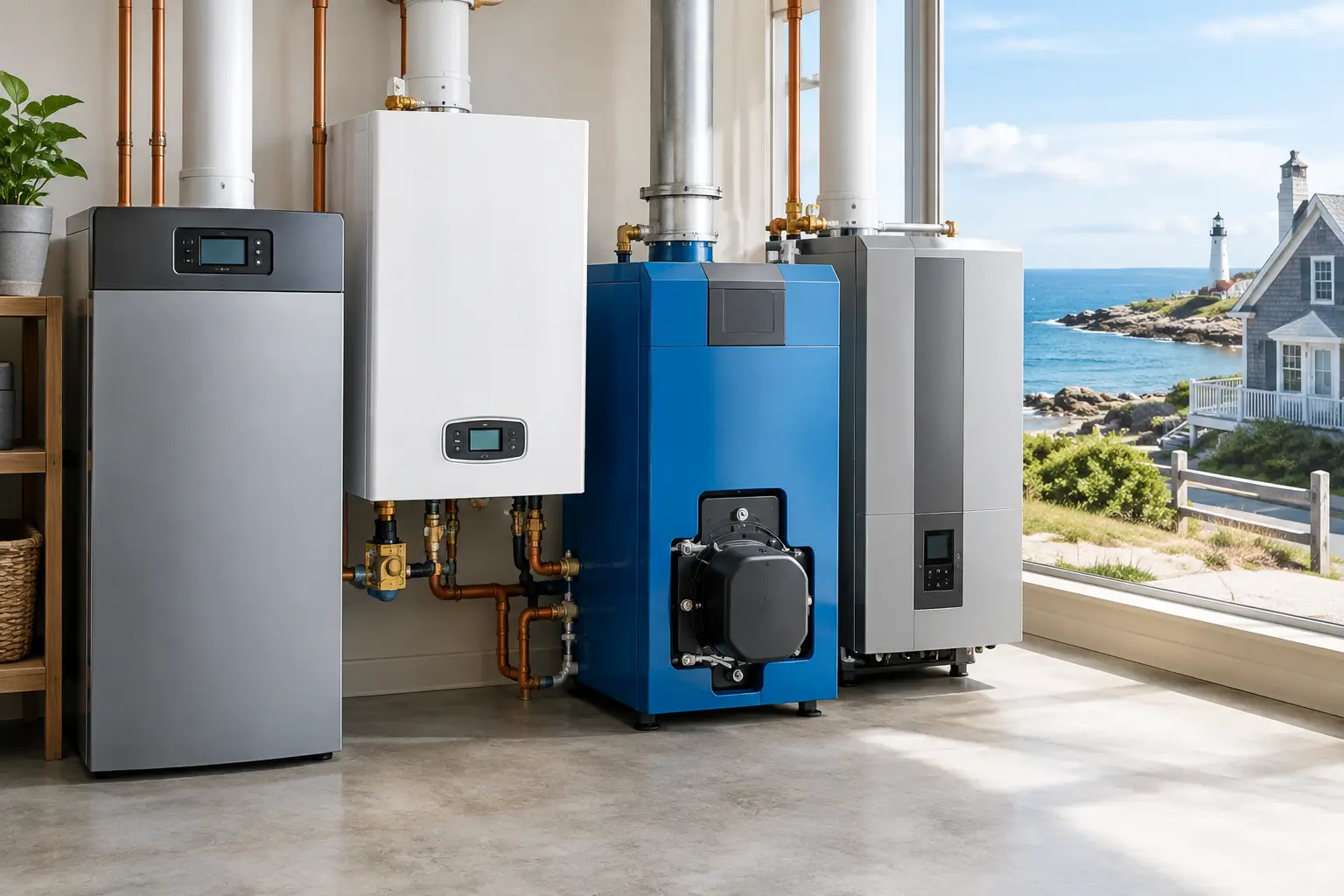
A boiler that keeps a Cape Cod home warm through a nor'easter is not necessarily the boiler that makes sense for every property. Fuel availability, existing baseboard or radiant heat, home size, venting access, water quality, and the availability of qualified local service all affect the right choice. This boiler brands comparison looks beyond name recognition to help homeowners and property managers evaluate what will hold up, operate efficiently, and be practical to maintain.
Start With the Boiler Type, Not the Logo
Before comparing manufacturers, determine whether your building needs a conventional cast-iron boiler, a high-efficiency condensing boiler, or a combination boiler that provides both space heating and domestic hot water.
Conventional boilers are generally simpler and can be a good fit when replacing an older oil or gas boiler connected to baseboard radiators. Many have a lower upfront cost than premium condensing equipment and are familiar to service technicians. Their trade-off is lower seasonal efficiency, especially if the system runs at higher temperatures all winter.
Condensing boilers recover more heat from exhaust gases, which can substantially reduce fuel use when installed and controlled correctly. They work especially well with radiant heating, oversized baseboards, or other low-temperature distribution systems. They also need proper condensate drainage, correct venting, annual maintenance, and water treatment when system water conditions call for it.
A combi boiler combines a high-efficiency boiler and tankless water heater in one cabinet. It can free up valuable space in a smaller home, condo, or rental property. However, a combi unit must be sized for hot-water demand as well as heating load. A household with several bathrooms and frequent simultaneous showers may be better served by a boiler paired with an indirect water heater.
Boiler Brands Comparison: What Actually Separates Them
The best boiler brand is rarely the one with the biggest advertising budget. It is the model that fits the building, can be installed to manufacturer specifications, and has local parts and service support. The following brands are commonly considered for residential and light-commercial heating projects.
Weil-McLain
Weil-McLain has a long history in both cast-iron and high-efficiency boiler categories. It is often a practical option for homeowners replacing an aging boiler because the product line includes choices suited to traditional hydronic systems as well as more modern condensing applications.
The appeal is flexibility. A properly selected Weil-McLain cast-iron model may make sense for a straightforward replacement where system temperatures are high and simplicity is the priority. Its condensing options can be worth considering for efficiency-focused upgrades. As with any condensing boiler, installation quality matters: piping, venting, combustion setup, and annual cleaning should never be treated as optional.
U.S. Boiler Company and Burnham
Burnham is a familiar name in many New England mechanical rooms, and U.S. Boiler Company offers a range of gas- and oil-fired equipment. These brands are frequently considered for replacement installations because contractors and property owners recognize their conventional boiler designs and broad application range.
For a home with existing baseboard heat, a conventional cast-iron boiler from this category can be a sensible long-term choice when reliability and serviceability outweigh the highest possible efficiency rating. Some product lines also offer high-efficiency options. The right selection depends on the heat-loss calculation and the temperature requirements of the existing distribution system, not simply on what was installed decades ago.
Navien
Navien is well known for condensing tankless water heaters and compact, high-efficiency boilers. Its boiler and combi options are often attractive where floor space is limited or where a homeowner wants to replace separate heating and water-heating equipment with one efficient system.
The benefits can be meaningful: high efficiency, compact dimensions, and advanced controls. The trade-off is that these systems are more dependent on correct commissioning and regular maintenance than a basic conventional boiler. The installer should verify gas supply capacity, venting routes, condensate disposal, water quality, and the unit's ability to meet real hot-water demand.
Lochinvar
Lochinvar is commonly associated with high-efficiency condensing boilers for both residential and commercial use. Its equipment is often a strong candidate for larger homes, multi-unit properties, and buildings with more complex heating loads or zoning needs.
A Lochinvar system can offer sophisticated controls and strong efficiency potential, particularly when the heating system can operate at lower water temperatures. Those advantages are best realized when the system is designed as a whole. Oversizing the boiler, skipping proper hydraulic separation, or leaving controls poorly configured can reduce comfort and erase much of the expected savings.
Bosch
Bosch is another recognized option in the high-efficiency boiler market. Homeowners may consider Bosch when looking for a compact gas-fired condensing boiler with modern controls and a manufacturer known across heating and hot-water equipment.
As with other condensing brands, a Bosch boiler may be an excellent fit for a properly designed low-temperature system. It may be less compelling as a direct replacement for a high-temperature system if no effort is made to improve distribution, controls, or boiler sizing. Ask the installing contractor how the equipment will be matched to the existing radiators or baseboards.
Efficiency Ratings Tell Only Part of the Story
Annual Fuel Utilization Efficiency, or AFUE, is useful for comparing how efficiently boilers convert fuel into heat under standardized testing conditions. A higher rating can reduce operating costs, but it does not guarantee lower bills in every home.
A 95% efficient condensing boiler may not operate at peak efficiency if it is oversized, short-cycles, or is connected to a system that constantly returns very hot water. Conversely, an appropriately sized conventional boiler with well-maintained controls can provide dependable comfort for many years.
For Cape Cod homes, insulation levels, wind exposure, foundation conditions, and intermittent occupancy all matter. A seasonal property may have different operating priorities than a year-round family home. The answer may be efficiency, durability, freeze protection, remote monitoring, or some combination of all four.
The Installation Determines the Outcome
Brand comparisons are helpful, but the quality of installation has as much influence on performance as the badge on the front of the boiler. A professional proposal should account for a room-by-room or whole-home heat-loss calculation, not just the capacity of the existing boiler.
It should also address venting, combustion air, gas piping or oil supply, expansion tank sizing, circulators, zone valves, water quality, condensate neutralization where needed, and safe relief-valve discharge. These details affect efficiency, noise, reliability, and manufacturer warranty compliance.
For commercial properties, the stakes are higher. A boiler failure can disrupt tenants, customers, employees, and plumbing systems in cold weather. Redundancy, staged boiler operation, controls, and access for maintenance may matter more than selecting the lowest initial price.
Questions to Ask Before Choosing a Brand
Ask whether the proposed boiler is sized from a current heat-loss calculation and whether it is designed for your existing emitters. Confirm who will service the equipment locally, how quickly common parts can be obtained, and what annual maintenance the model requires. If you are comparing a combi unit with a boiler and indirect tank, ask for the expected hot-water performance during simultaneous use.
Also ask about warranty terms, labor coverage, financing, and applicable Mass Save incentives. Rebates and financing can make a higher-efficiency installation more attainable, but they should support a sound equipment decision rather than drive it.
A dependable boiler choice comes down to more than a familiar brand name. For homeowners and property managers, the most useful next step is a thorough onsite evaluation from a licensed heating professional who can match the equipment, installation plan, and service support to the building you are responsible for.



