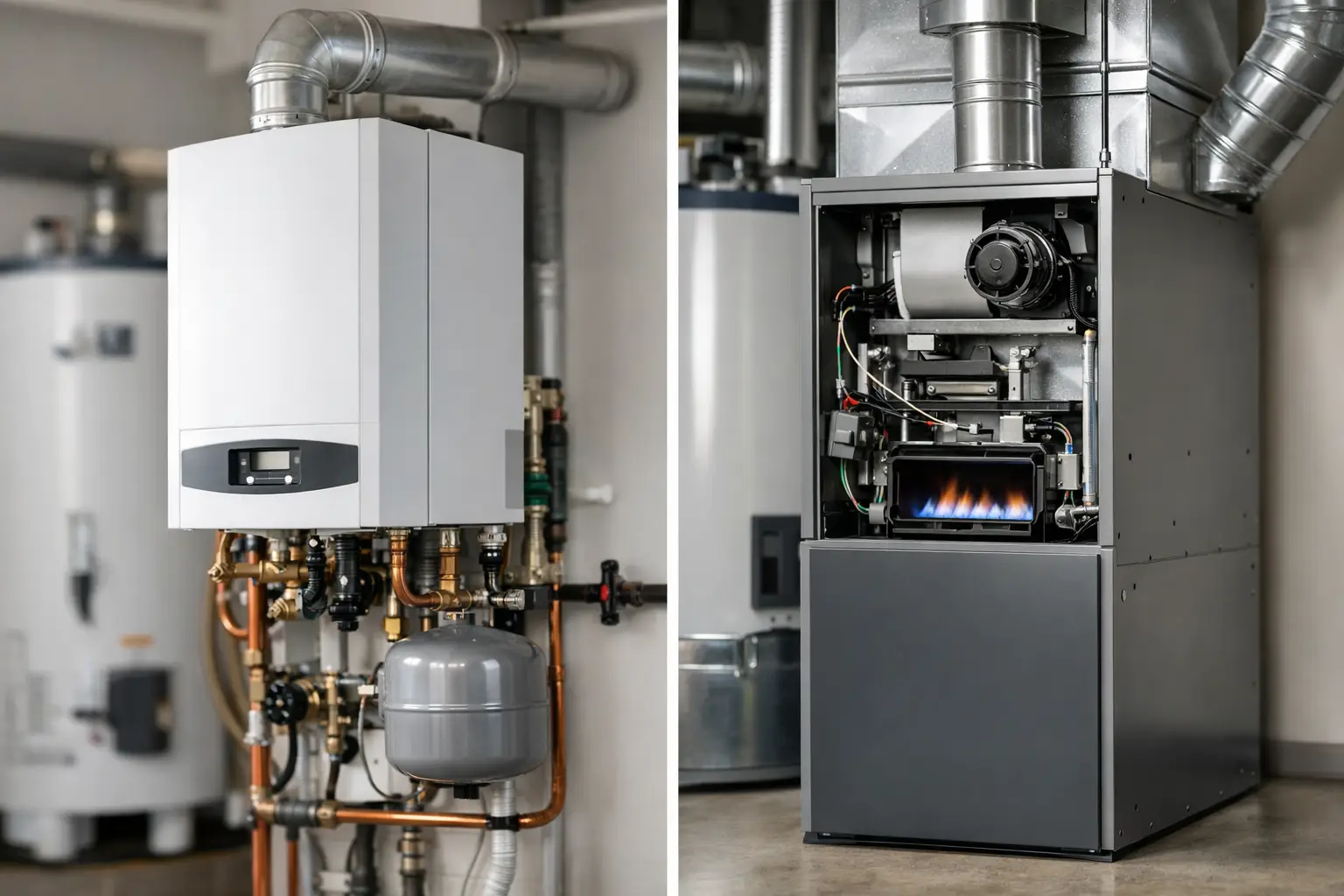
If your heating system is aging, the boiler vs furnace efficiency question matters more than most homeowners expect. The answer affects your fuel bills, indoor comfort, maintenance needs, and how your building handles a Cape Cod winter when temperatures drop and reliability stops being optional.
A lot of people assume the more efficient system is always the better buy. Not necessarily. Boilers and furnaces move heat in different ways, and those differences show up in monthly costs, repair history, installation complexity, and even how each room feels on a cold morning.
Boiler vs furnace efficiency: the basic difference
A boiler heats water and sends that heat through radiators, baseboard units, or in-floor tubing. A furnace heats air and distributes it through ductwork. Both can run on gas, oil, propane, or electricity depending on the setup, but they deliver heat very differently.
That matters because efficiency is not just about the number on the equipment label. It is also about how heat travels through the home, how much is lost on the way, and whether the system matches the building itself.
With a furnace, heated air can lose energy through leaky or poorly insulated ducts. With a boiler, the system avoids duct losses, but older hydronic setups can still waste energy if pumps, controls, or piping are outdated. So when people ask which one is more efficient, the honest answer is that modern boilers often have an edge on heat delivery, while modern furnaces can still perform very well in the right home.
AFUE ratings tell part of the story
The main efficiency rating for boilers and furnaces is AFUE, or Annual Fuel Utilization Efficiency. If a unit has a 95% AFUE, it converts about 95% of its fuel into usable heat over a typical season. The remaining 5% is lost, usually through exhaust or other operating inefficiencies.
Most older systems are nowhere near that number. An older boiler or furnace may be operating in the 60% to 80% range, especially if maintenance has been inconsistent. That is one reason replacement can make a noticeable difference in operating cost.
High-efficiency condensing furnaces and boilers can both reach the mid-90s and sometimes higher. On paper, that makes them look almost equal. In practice, the real-world result depends on the house. A high-efficiency furnace connected to old, leaky ducts may not deliver the savings its AFUE suggests. A high-efficiency boiler in a poorly zoned system may also fall short of expectations.
Why boilers often feel more efficient
Many homeowners describe boiler heat as steadier and more comfortable. That is because water holds heat better than air, and hydronic systems usually provide a more even temperature without the frequent blasts and shutoffs common with forced-air systems.
This can create the feeling of better efficiency because the home stays comfortable at a consistent thermostat setting. In some cases, people feel warm enough at a lower setpoint with a boiler than they would with a furnace. Lower thermostat settings can reduce fuel use.
Boilers also avoid the duct losses that can reduce furnace performance. If ductwork runs through unconditioned spaces like attics, crawl spaces, or garages, a furnace system can lose a meaningful amount of heat before it ever reaches the living area.
Still, boilers are not automatically the winner. If the boiler is older, oversized, or paired with outdated controls, it can short-cycle and burn more fuel than necessary. Efficiency depends on the whole system, not just the type of equipment.
Where furnaces can come out ahead
A furnace can be the better efficiency choice when the home already has well-designed ductwork in good condition. If the ducts are sealed, insulated, and properly sized, a high-efficiency furnace can deliver strong performance at a lower installation cost than converting to a boiler system.
Furnaces also heat spaces quickly. That is not always the same as higher efficiency, but it can be useful in buildings where fast temperature recovery matters. Some property owners also prefer forced air because the same duct system can support central air conditioning, filtration, humidification, and ventilation upgrades.
That shared infrastructure can simplify the mechanical setup. In homes where cooling is a major concern, a furnace may fit more naturally into the larger HVAC picture.
Boiler vs furnace efficiency in older homes
Older homes are common across southeastern Massachusetts, and they often change the conversation. A lot of these properties were built before modern energy standards, and many have a patchwork of upgrades from different decades.
In an older home with existing radiators or baseboard heat, keeping or upgrading a boiler may make more sense than forcing a major duct installation into the structure. Boiler systems can work especially well in homes where preserving layout and minimizing renovation is a priority.
On the other hand, some older homes already have ductwork that was added later, sometimes with mixed results. In those cases, efficiency depends on inspection. If the ducts are undersized, unsealed, or routed poorly, the furnace may be fighting the house instead of heating it efficiently.
This is why a proper evaluation matters. The best system is the one that works with the building, not against it.
Installation cost vs operating cost
One of the biggest trade-offs in boiler vs furnace efficiency is upfront cost versus long-term savings. Boilers usually cost more to install, especially if the home does not already have hydronic piping, radiators, or baseboard infrastructure. Furnace installations are often less expensive when usable ductwork is already in place.
But lower installation cost does not always mean lower ownership cost. If a boiler reduces heat loss and maintains comfort with less cycling, the operating savings may justify the higher upfront investment over time. The opposite can also be true. If a furnace can use existing ductwork efficiently and avoid major remodeling, it may offer the better value.
Fuel type matters here too. Natural gas, propane, oil, and electric heating all come with different operating costs and equipment options. That is one reason simple internet averages only go so far.
Maintenance and repair considerations
Efficiency is easier to protect when a system is maintained properly. Boilers and furnaces both need annual service, but the service points differ.
Boilers need attention to burners, heat exchangers, expansion tanks, circulator pumps, pressure levels, air removal, and safety controls. Furnaces need inspection of burners, heat exchangers, blowers, filters, ignition systems, venting, and duct performance.
A neglected furnace can lose efficiency through dirty filters, airflow restrictions, and duct leakage. A neglected boiler can lose efficiency through scale buildup, air in the system, pump issues, or poor combustion tuning. Neither system stays efficient by accident.
For property managers and homeowners, reliability should be part of the efficiency decision. A system that performs well on paper but struggles with repeated service calls is not giving you full value.
Comfort, air quality, and noise
Efficiency numbers do not capture everything that affects day-to-day satisfaction. Boilers tend to run quieter and create less air movement, which some people prefer. They also do not circulate dust the way forced-air systems can.
Furnaces have their own advantages. They can work with better filtration, fresh-air systems, humidifiers, and whole-home cooling. If indoor air quality is a top concern, a well-designed forced-air system may offer more ways to manage the indoor environment.
This is where priorities matter. If your focus is steady heat and quiet operation, a boiler may feel like the better fit. If you want one integrated system that supports heating, cooling, and air treatment, a furnace may make more sense.
Which system is more efficient for your property?
If you want the shortest honest answer, a modern boiler often delivers heat more efficiently inside the home because it avoids duct losses and provides even comfort. A modern furnace can still be highly efficient, especially in buildings with quality ductwork and combined heating and cooling needs.
So the better question is not just boiler or furnace. It is which system fits your home, fuel source, existing infrastructure, and comfort goals with the fewest compromises.
For many homeowners in places like Barnstable, Hyannis, and Falmouth, the right answer comes down to the condition of the current system and the house around it. A licensed heating professional can evaluate AFUE, duct losses, heat distribution, insulation levels, and equipment age to show where your real efficiency losses are happening.
If your current system is running constantly, heating unevenly, or driving up utility bills, the smartest next step is not guessing based on equipment type alone. It is getting a clear look at how your actual system performs. The best heating upgrade is the one that keeps your property comfortable, dependable, and affordable when winter puts it to work.