
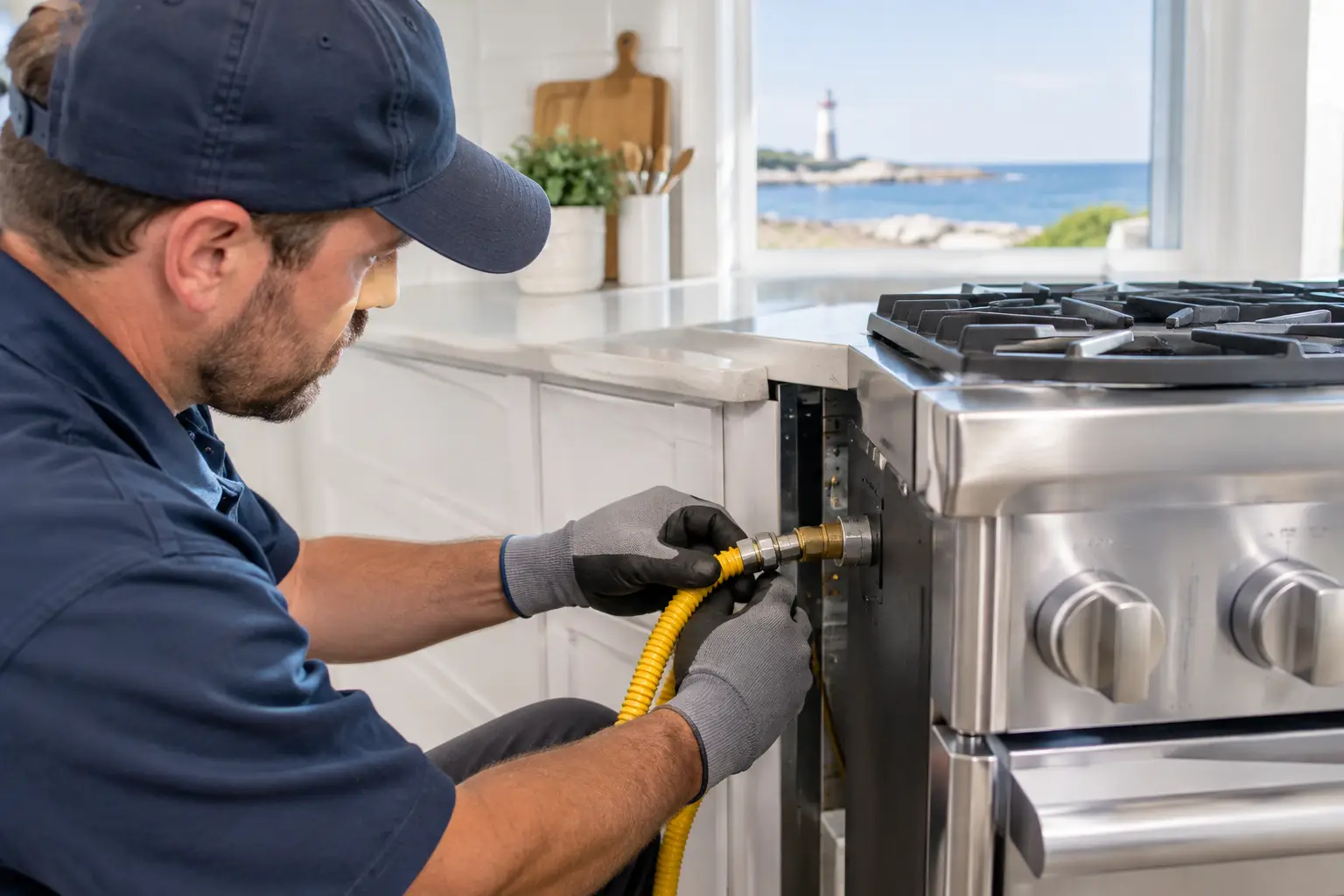
A gas range can be a practical kitchen upgrade, but the appliance price is only part of the project. The gas line for stove installation cost depends on whether gas is already available in the kitchen, how far the new line must run, and whether your existing gas system has enough capacity. For Cape Cod homeowners, permit requirements and the layout of older homes can also affect the final price.
A licensed gas professional should assess the entire run before quoting the work. That protects your home, helps avoid delays during installation, and ensures the range receives the correct gas supply.
What Does a Gas Line for Stove Installation Cost?
For a straightforward stove hookup where a properly sized, code-compliant gas line and shutoff valve are already in place, the installation cost is usually much lower than running new piping. If a technician only needs to connect the range, test for leaks, and confirm proper operation, homeowners may spend a few hundred dollars.
A new gas line installation for a stove often falls in a broader range of roughly $500 to $1,500 or more. Projects at the lower end tend to involve a short, accessible run from an existing nearby branch line. Costs rise when the line must travel through a basement, crawlspace, finished walls, masonry, or a long route from the gas meter or propane tank.
Some projects can exceed that range. A larger job may require upsizing portions of the gas piping, adding capacity at the meter, coordinating with a utility or propane supplier, repairing finished surfaces after access work, or addressing an older system that does not meet current code. An on-site assessment is the reliable way to price those variables.
The Details That Change Your Price
The length of the pipe matters, but it is not the only cost driver. Access, system capacity, fuel type, and local permitting all deserve attention before you choose a range or schedule installation.
Is gas already near the kitchen?
This is usually the biggest question. A home with an existing capped gas line behind the stove may only need a final connection, a new flexible appliance connector, a sediment trap where required, and leak testing. That is very different from bringing gas from the other side of the house.
Many Cape Cod homes have heating equipment, water heaters, fireplaces, dryers, or generators that already use natural gas or propane. Even then, an existing gas supply does not automatically mean there is an appropriately sized branch for a new range. The line must be evaluated for the full demand of every connected appliance.
How difficult is the route?
Open basements and unfinished utility areas generally allow for faster, less disruptive work. A route through a finished kitchen, slab foundation, tight crawlspace, or exterior masonry takes more labor and may involve restoration work afterward.
Older homes can add another layer of planning. Joist directions, stone foundations, prior renovations, and limited access points can make a short distance more complicated than it looks on a floor plan. A professional quote should account for the actual path, not just the straight-line distance between the meter and stove.
Does the gas system have enough capacity?
Gas piping is sized based on the combined BTU load of connected appliances and the length of the runs. A new stove may be a modest addition, but it still has to be included with the furnace, boiler, water heater, dryer, fireplace, pool heater, or generator.
If the current system is near its limit, adding a stove can require a larger branch line or changes to the main piping. This is not an area to guess at or solve with an undersized connection. Poor sizing can lead to weak appliance performance, pressure issues, and safety concerns.
Natural gas and propane are not interchangeable
Both fuels can serve a gas range, but the appliance must be set up for the fuel at your property. Some ranges include a conversion kit, while others need specific components or manufacturer-approved adjustment. The gas line, shutoff, connector, and testing process should all be handled according to applicable codes and the appliance manufacturer’s requirements.
For propane homes, tank location and the condition of the regulator may also affect the scope. If you are switching fuel types, ask about the complete project rather than pricing only the indoor connection.
Permits, Inspections, and Code Requirements
A gas line is not a typical DIY project. Massachusetts requires properly licensed professionals for gas fitting work, and permits and inspections are commonly part of a new line installation. These requirements are there for a reason: gas leaks and improper venting or combustion setup can create serious hazards.
Permit costs vary by municipality, and the inspection schedule can affect project timing. In some cases, the line can be installed and inspected before the appliance arrives. In others, final connection and testing are coordinated around the delivery date. Planning this early is especially useful during a kitchen renovation, when walls and floors may be open.
A code-compliant installation typically includes an accessible shutoff valve near the appliance, approved piping materials, proper support and protection for the line, and a pressure or leak test. Your installer should also verify that the range is located and connected in accordance with its manufacturer instructions.
What a Clear Installation Quote Should Include
The lowest number is not always the lowest finished cost. A useful quote defines the work clearly, including where the line begins and ends, the proposed route, pipe sizing, shutoff valve, appliance connection, testing, permit responsibility, and any expected patching or access work.
Before approving an estimate, ask whether the price includes the following:
- A capacity calculation for the existing gas system
- Permit and inspection coordination, when required
- The shutoff valve, connector, fittings, and sediment trap if applicable
- Leak testing and final appliance connection
- Any exclusions for wall repair, cabinetry, electrical work, or appliance conversion
These details help prevent a surprise change order after work begins. They also make it easier to compare estimates fairly. One contractor may price only a basic connection, while another has included the new branch piping, permit, and inspection from the start.
Ways to Keep the Project Within Budget
The best way to control cost is to plan the gas line before the kitchen is finished. If walls are open for a remodel, the installer can often run pipe with less demolition and repair. Choosing a stove location near an existing gas branch may also reduce labor, provided the system has adequate capacity.
It is also smart to schedule related gas work together. If you are considering a gas dryer, fireplace insert, water heater, or standby generator, tell the technician during the initial visit. Designing the system for planned loads can be more cost-effective than repeatedly modifying undersized piping later.
Do not cut costs by using an unlicensed installer or by treating a flexible connector as a substitute for permanent gas piping. Appliance connectors have a specific purpose and installation standard. The permanent line, shutoff, and fittings must be correctly selected and installed for the job.
When to Call for an Evaluation
Call for a professional assessment before purchasing a gas range if you are unsure whether the home has natural gas or propane service, cannot locate a shutoff behind the existing stove, are converting from electric to gas, or are adding other gas appliances at the same time. A visit can identify capacity limitations before a delivery crew arrives with an appliance that cannot be connected that day.
If you smell gas, hear hissing near a line or appliance, or suspect a leak, leave the area if necessary, avoid switches and open flames, and contact your gas utility or emergency services as appropriate. Do not attempt to locate or repair a suspected leak yourself.
For homeowners and property managers in Cape Cod, a licensed team such as Durfee Plumbing & Heating can assess the route, explain the permit process, and provide a clear scope before work begins. A properly planned gas line lets you enjoy your new stove with the confidence that the connection was built for safe, dependable service.



