
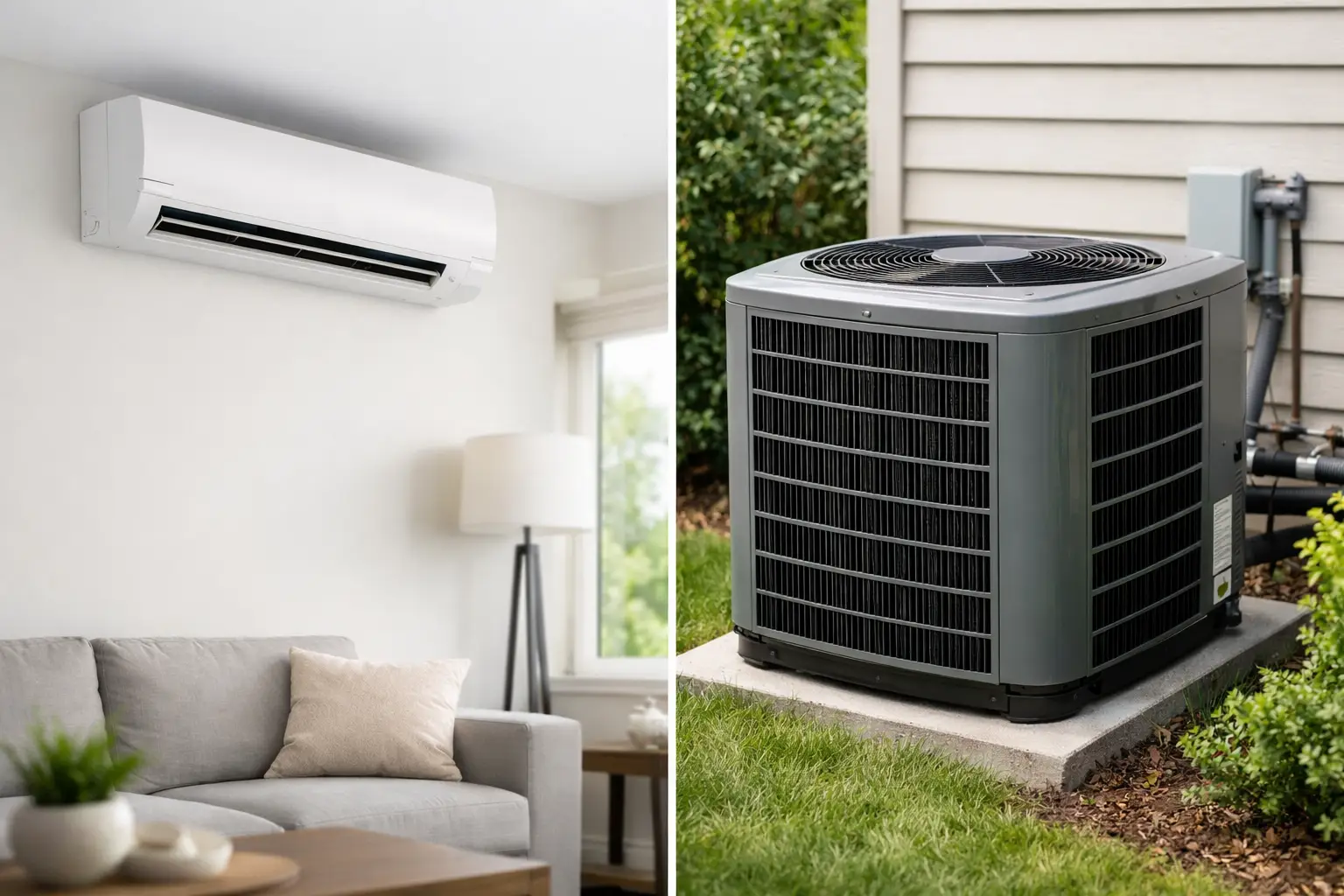
A failed air conditioner in July makes the decision feel urgent, but the right replacement should also work for your home in October, January, and every shoulder season in between. When homeowners ask, “ductless mini-split vs central ac which to choose,” the answer usually comes down to your existing ductwork, the rooms you use most, your budget, and whether you want heating as part of the upgrade.
Central air remains a strong choice for many Cape Cod homes, especially those with usable ducts. Ductless mini-splits can be a smarter fit for additions, older homes, converted spaces, and households that want room-by-room comfort control. Neither system wins every time.
Ductless Mini-Split vs Central AC: The Core Difference
A central air conditioning system cools your home through a network of supply and return ducts. One outdoor condenser works with an indoor coil, usually located near a furnace or air handler, and a thermostat controls the system for the house or a major zone.
A ductless mini-split has an outdoor unit connected to one or more indoor air handlers by small refrigerant lines and electrical wiring. Each indoor unit serves a specific room or area. Most modern mini-splits are heat pumps, so they provide efficient cooling in summer and heating in cooler weather.
That design difference changes nearly every practical consideration, from installation work to daily comfort. A central system treats the home more as a whole. A mini-split lets you treat different rooms according to how they are actually used.
When Central AC Is the Better Choice
Central AC is often the practical choice when a home already has ductwork in good condition. If your property has a forced-air furnace or an existing ducted cooling system, replacing the outdoor equipment and indoor coil may be less disruptive than installing multiple wall-mounted units.
It also provides a familiar, relatively unobtrusive look. Conditioned air comes through registers rather than visible indoor heads, which matters to homeowners who want to preserve wall space or a particular interior design. With properly designed ducts, central air can cool multiple bedrooms, hallways, living spaces, and kitchens from one coordinated system.
Central air may be especially appealing if your household prefers one thermostat setting throughout the home. It can also pair well with whole-home air filtration, humidification, and other duct-based indoor air quality equipment. For a large, open home with sound ductwork and consistent occupancy, central AC can deliver straightforward whole-house comfort.
The important qualifier is the ductwork itself. Leaky, undersized, poorly insulated, or poorly balanced ducts can waste conditioned air and leave certain rooms uncomfortable. Before committing to a new central system, have the ducts inspected. Installing a high-efficiency condenser will not solve airflow problems hiding behind walls, ceilings, or crawlspaces.
When a Ductless Mini-Split Makes More Sense
Ductless mini-splits solve problems that central systems cannot solve easily without major remodeling. They are well suited to homes without existing ducts, where adding a full duct system would require opening finished walls, lowering ceilings, or sacrificing closet space.
They are also useful when only part of a home needs better cooling. A finished attic that overheats, a sunroom, an enclosed porch, a garage conversion, or a new addition may not receive enough airflow from the existing central system. A single-zone mini-split can condition that space without putting more demand on the rest of the house.
For many Cape Cod properties, the heating function is a major advantage. A cold-climate heat pump mini-split can provide efficient heat during much of the year, reducing reliance on oil, propane, or electric resistance heat. The right system must be selected for local winter conditions and sized correctly, but it can be an effective part of a home’s heating plan.
Zoning is another reason homeowners choose mini-splits. If a guest room sits empty most of the week, there is no need to cool it to the same level as the occupied living room. Each indoor head has its own controls, allowing family members to adjust rooms to their comfort preferences. That can reduce wasted energy, though it requires everyone to use the system thoughtfully.
Compare Installation Cost, Appearance, and Disruption
Upfront cost depends on the equipment, home layout, electrical capacity, and amount of work required. A central AC replacement where compatible ducts already exist can be more economical than installing a multi-zone mini-split system. But central air becomes more expensive when new ducts, duct repairs, or major renovations are needed.
A mini-split installation usually requires a small opening through an exterior wall for the line set. That is far less invasive than building duct runs through an older home. However, a whole-home multi-zone setup can involve several indoor units, condensate management, electrical upgrades, and careful placement of the outdoor equipment. It should not be treated as a simple one-day equipment swap without a site evaluation.
Appearance is personal. Some homeowners dislike the look of wall-mounted air handlers. Options such as ceiling cassettes, floor-mounted units, and concealed ducted mini-split handlers can reduce their visibility, but those choices may affect cost and installation complexity. Central air keeps equipment mostly out of sight, while mini-splits make the comfort source more visible.
Efficiency Does Not Mean the Same Thing for Every Home
Both systems are available in high-efficiency models. Central AC efficiency is commonly measured by SEER2, while heat-pump mini-splits also use SEER2 for cooling and HSPF2 for heating performance. Higher ratings can lower energy use, but the right system size and installation quality matter just as much.
Mini-splits can be highly efficient because they avoid losses from duct leakage and allow room-by-room control. They also use inverter-driven compressors that can adjust output rather than cycling fully on and off as often. That helps maintain steady temperatures and can improve comfort during humid Cape Cod summers.
Central air can perform very efficiently when ducts are sealed, insulated, and designed for the equipment. It may be the better real-world choice if your home has a layout that benefits from whole-house circulation and you do not want multiple indoor zones to manage.
Avoid choosing solely by the highest efficiency number on a brochure. Oversized equipment can short-cycle, remove less humidity, and wear components faster. Undersized equipment can run constantly on the hottest or coldest days. A licensed HVAC technician should calculate the heating and cooling load based on your home, insulation, windows, orientation, and occupancy instead of relying on square footage alone.
Comfort, Humidity, and Noise
On Cape Cod, humidity control is part of cooling comfort. A house that reaches the thermostat setting but still feels damp is not performing as it should. Properly sized central systems and mini-splits can both remove moisture, but system selection and setup make a difference.
Mini-splits are often very quiet indoors and outdoors. Their lower-speed operation can maintain a more even temperature with fewer noticeable starts and stops. Central air is also quiet when installed well, although airflow noise can become noticeable if ducts are undersized, registers are restrictive, or the blower is improperly set.
Central air may circulate air more evenly through connected rooms. Mini-splits work best when the indoor units have a clear path to distribute air through the areas they serve. A head in one room does not automatically provide equal comfort behind closed bedroom doors, around tight corners, or on another floor. Multi-zone planning matters.
Which System Fits Your Home?
Use the condition of your home, not a one-size-fits-all recommendation, to guide the decision.
- Choose central AC when you have sound existing ducts, want discreet whole-home cooling, and prefer one primary thermostat.
- Choose ductless mini-splits when your home lacks ducts, you are conditioning an addition or problem room, or you want efficient heating and cooling by zone.
- Consider a mixed approach when you have central air for the main house but need a mini-split for an attic, sunroom, office, or addition.
- Request a load calculation and duct evaluation before replacing any major HVAC equipment, particularly in an older home or after insulation, window, or renovation work.
Financial incentives can also influence the project. Qualifying heat pumps may be eligible for Mass Save rebates, and financing can make a larger efficiency upgrade more manageable. Eligibility and available amounts can change, so confirm current program requirements before making a final equipment decision.
Get a Recommendation Based on Your House
The best choice is rarely the one your neighbor installed. Two similar-looking homes can need very different solutions because of duct condition, insulation levels, room layout, fuel type, and how the occupants use the space.
A professional assessment should include more than an equipment quote. It should account for airflow, electrical needs, outdoor unit location, condensate drainage, winter heating expectations, and the rooms that are consistently too hot or too cold. Durfee Plumbing & Heating can help Cape Cod homeowners compare practical options with licensed HVAC guidance, clear installation planning, and a solution sized for the property.
Choose the system that fixes the comfort problem you have now while giving your home a dependable path through the next heating and cooling season.